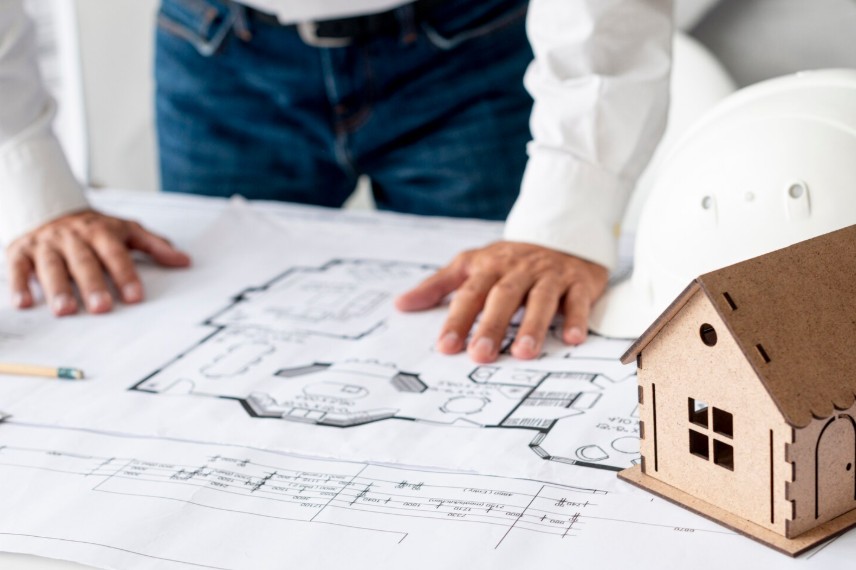
You may not know how many square meters you need. Or whether you prefer an open or closed kitchen. You may know you want light, silence, and that feeling of calm when you walk in. Or maybe you’re starting from the roof down (more common than you’d think).
It’s okay. You don’t have to know everything. What matters is that if you’re here, there’s something in you that wants to stop searching for houses built by others—and start imagining one made by and for you.
I’m not going to sell you a villa. That comes later, if it comes at all. But I do want to tell you what really happens when you decide to take that step. What the timing is like, the beautiful moments and the ones that also exist (because not everything is Instagram). And above all, what you can truly expect from the entire design process of a villa, from the first conversation to the moment the key turns in the lock.
Okay, I want a different home. But what awaits me on that path?
Spoiler: much more than what you see on a blueprint.
Building a custom villa is not ordering a house and waiting in your chair. But it also shouldn’t become your new full-time job. If you choose the right team, you’ll not only live the process with less tension—you might actually enjoy it.
Let me tell you how we do it at The Villas Architect. Not because our method is the only one, but because it’s designed to realistically support people who want to do things well. With discernment. With taste.
We’ll talk about decisions. About pacing. About phases that feel endless and others that fly by. About the stages of building a villa, real delivery timelines (not the ones summed up in two marketing sentences). About how we help you see the result before building it. And why design is not something handed to you, but something we create with you.
Major decisions that happen before laying the first stone
A good house starts long before the blueprint: it starts with listening
Sometimes people arrive with 50 references from Pinterest, beautiful renderings, loose ideas… but no clear story. And instead of helping, that blocks the process. Design is not copying beautiful things. It’s understanding you. And if the project doesn’t start from you, course-correcting later becomes much harder.
That’s why the first thing we do is not design. It’s listen.
The plot is not a backdrop: it’s the silent protagonist
A plot is much more than its size. It’s orientation, slope, vegetation, breeze, sun, views. Some plots condition everything. Others inspire everything. Analyzing them well can mean the difference between a house that “looks good” and one that feels like it was always meant to be there.
Design isn’t about styles. It’s about people
Some clients think they want a minimalist home. But when we show them materials, textures, circulations, they realize what they actually want is warmth. Others come wanting something Mediterranean, and end up asking for clean lines and high ceilings.
That’s why, instead of starting with “What style do you want?”, we start with “What makes you feel at home?”
Phases of the process: what happens and what you feel in each stage
1. Preliminary design: when everything is still undecided (and that’s okay)
This is the moment to play, test, explore. We sketch, create options, make initial renderings. Some ideas fall away; others take shape. Some people get excited; others get overwhelmed. Everything is valid. This phase is meant to accompany, not impose.
2. Technical project: turning emotions into structure
Now we come down to earth—literally. We calculate, define materials, installations, regulatory compliance. It’s usually the least visible stage, but if it’s done poorly everything wobbles. If it’s done well, everything flows.
3. Permits, paperwork and other bureaucratic creatures
We take care of it. We’ll only ask you for something when it’s truly necessary. And when we do, we’ll explain it without jargon. Because this should not become a paperwork marathon for you.
4. Construction: dirt, dust, noise… and magic
This is the longest phase and the one that generates the most anticipation. Because it’s no longer drawings—it’s real. We supervise every part, keep you informed, show you progress. And if there are unforeseen events (there always are), they’re managed. Without drama.
5. Delivery: the house is yours (although it already was before)
It’s not just handing you a key. It’s reviewing everything with you, fixing details, explaining how everything works. And staying available in the weeks that follow, when the real questions appear: how does this system work, what happens if…
Things you don’t see in photos, but change the entire experience
Choosing materials without losing your mind
You don’t have to know everything. But you do need someone who listens when you’re torn between two floors or unsure whether that tap you love will age well. We go with you, explain, compare—and in the end, you decide with clarity.
Sustainability without showing off
Overhangs that provide shade in summer and let sunlight in during winter. Windows that ventilate without overworking heating or cooling. Walls that insulate without feeling like a bunker. We design this from the start. Not as an add-on.
Real timelines
Each phase has its timing. And timelines are met when planned from truth, not from marketing. That’s why we give you a schedule from day one, with realistic margins. And if something changes, we talk about it.
Some questions we’ve already answered (and that you probably ask too)
What if I don’t like the final result?
You won’t reach that point without having seen it first. We visualize everything with you from the beginning. And if something feels off, we fix it in the model—not on the bricks.
Can I get involved? Or should I just let you guide me?
You can be as involved as you want. Some people want to be part of everything; others delegate with confidence. What matters is that you feel you have room to decide—and freedom not to.
What if I regret a choice?
It happens. That’s why we leave space in key phases to correct without tearing everything down. We design with that in mind.
Is this for me, even if I’ve never done something like this before?
That’s exactly why we’re here. Because no one should have to learn architecture to have a good home. We take care of that. And you take care of feeling that it makes sense.
Designing a villa is serious. But it can also be beautiful.
This is not just about square meters, or renderings, or how good it looks in photos. It’s about living well. About every corner having logic. About your home helping you live better, not just look better.
At The Villas Architect, we’ve spent years supporting people who seek something they can’t find already built. Who prefer creating a home that fits rather than adapting to one that doesn’t. And who want to live that process with someone who knows what they’re doing and explains it clearly.
If you’re at that point, maybe this is the first step. The next one could be a conversation.